This post is all about teaching kids about money.

Teaching Kids About Money – The Fun Ways
Money is often a tricky concept for kids to understand, but it’s one of the most valuable life lessons we can start teaching early. Even preschoolers can begin learning the basics. Like that money is earned through effort, that it can be saved for something special, and that spending always involves making choices. These early lessons help shape their sense of responsibility and independence as they grow. When it comes to teaching kids about money, you don’t need fancy programs or apps to start.
SEE THIS POST ON TIPS FOR USING THE BEAR BUCKS REWARD CHART SYSTEM
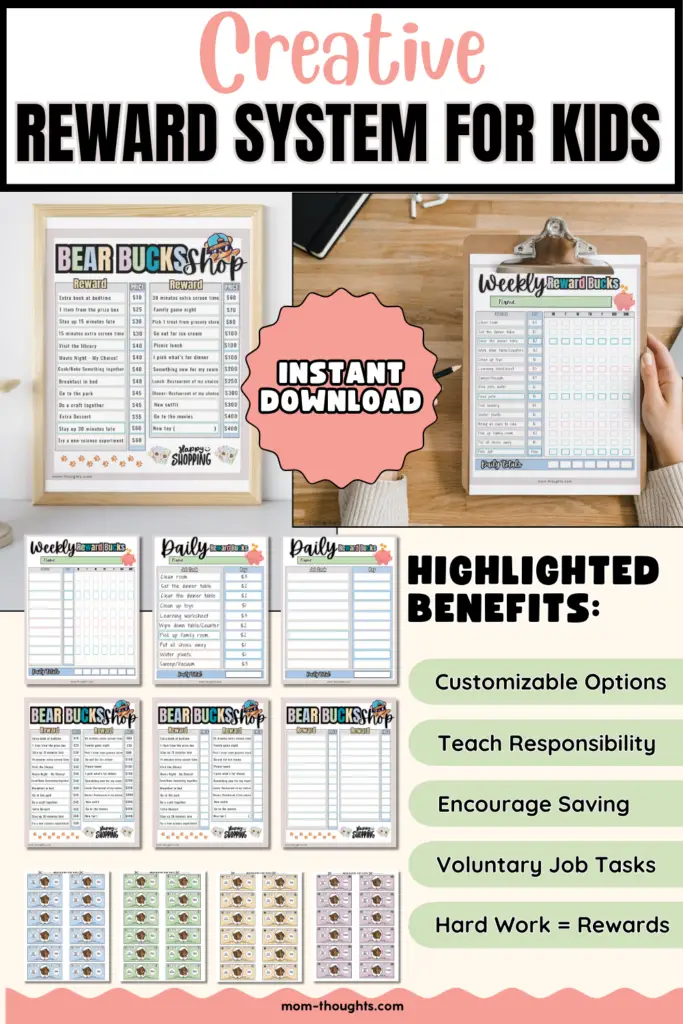
With just a few simple tools and some consistency, you can make learning about money both fun and meaningful. One of my favorite ways to do this is through the Bear Bucks Rewards System. It’s a printable system that uses adorable play money designed to represent $1, $5, $10, and $20 bills. Kids earn “Bear Bucks” for chores or positive behaviors, then save and spend them in a reward shop, just like real life! It’s a hands-on way for young kids to practice real-world money skills while also building good habits.
As a means for providing for my family I may earn a small commission if you purchase through the links on this page. Full Disclosure can be found here.
Why Teaching Kids About Money Matters
When kids learn how money works from a young age, they’re developing more than just math skills. In fact, they’re building life skills. They start to understand that effort has value, that saving leads to bigger rewards, and that patience pays off. These lessons carry over into how they approach schoolwork, friendships, and even decision-making as they get older.
Teaching kids about money also sets them up for long-term confidence. When they understand how earning, saving, and spending work, they grow up feeling capable and empowered instead of overwhelmed by finances later on. And the earlier we start these lessons, the easier it is for them to grasp the concepts naturally through play and daily routines rather than lectures or strict rules.
Start with the Basics: Earning Money
One of the best ways to teach kids about money is by showing them that it’s earned, not given. Kids can begin learning this concept as early as preschool, especially when you connect “earning” with helping around the house or showing responsibility. Even simple tasks like cleaning their room, setting the table, or feeding pets can earn them a little “income.”
That’s where the Bear Bucks Rewards Chart comes in handy. Each chore or task is assigned a specific value, like $1 for smaller jobs and $5 or $10 for bigger ones. Kids can clearly see how different amounts of effort lead to different rewards, and they love watching their earnings grow over time. It’s a great introduction to the real-world idea that work leads to money, and money gives you choices.
Parents can even take it a step further by holding a “payday” each week. This gives kids a tangible sense of earning and responsibility. Plus it makes it so much more exciting when it’s time to save or shop in the Bear Bucks reward store!
Saving and Budgeting: Making Smart Choices
Once kids start earning money, it’s the perfect time to teach them about saving. Even little ones can understand the excitement of setting a goal and working toward it. Maybe your child wants to “buy” a trip to the park or a movie night from the reward shop. Helping them save their Bear Bucks for something bigger teaches patience, discipline, and decision-making in a fun, age-appropriate way.
The Bear Bucks Rewards Chart makes this easy by connecting everyday chores to both short-term and long-term rewards. Kids can decide if they want to spend $10 on extra dessert tonight or save $100 for a trip to the ice cream shop. This naturally opens up conversations about budgeting, priorities, and the value of waiting for something worthwhile.
To make it visual, try giving your child an envelope or small box labeled “Save,” “Spend,” and “Shop.” Watching their Bear Bucks pile up in the “Save” section helps them feel proud of their progress. Plus, it teaches them that saving is rewarding in itself.
Spending Wisely: Learning Value Through Experience When Teaching Kids about Money
Spending is where all those money lessons come to life. When your child finally “shops” at the Bear Bucks Store, they start to understand the real value behind their choices. Maybe that extra 30 minutes of screen time costs $60, while a trip to the park costs $40, and they only have $70 to spend. Suddenly, they’re doing mental math, weighing options, and learning how to make trade-offs.
This is one of the best ways to teach kids that money isn’t endless. It also gives you the opportunity to talk about the difference between wants and needs in a gentle, practical way. As they make spending decisions, they’ll start to see how effort, saving, and smart choices connect. And to think, all without a single lecture!
One of the best parts is that when kids get to decide for themselves, the lessons stick. They learn that spending all their Bear Bucks today means they’ll have to earn more before buying something bigger later. These little “ah-ha” moments are exactly what set the stage for healthy money habits down the road.
Turning Lessons into Habits
Once your child understands the basics of earning, saving, and spending, the next step is consistency. Make money lessons part of your weekly rhythm. Set a specific “payday,” where your child gets their Bear Bucks for completed chores, and let them total up their earnings. You can even include a short “budgeting moment”. Such as helping them decide how much to save and how much to spend that week.
Keep the Bear Bucks system fun but structured. If your child forgets to do a task, it’s a natural chance to talk about how effort and follow-through connect to rewards. Over time, these small conversations add up to a big understanding of responsibility.
You can also celebrate milestones, like when your child saves up for a big reward or makes a thoughtful decision not to spend everything right away. The goal isn’t perfection. rather it’s helping kids connect their daily actions with real outcomes, in a way that feels positive and empowering.
Other Fun Ways to Teach Kids About Money
There are plenty of creative ways to reinforce money lessons outside the Bear Bucks system, too! Here are a few easy (and fun) ideas:
Play store or restaurant at home. You can take turns being the cashier to practice counting change.
Use board games that involve money. Games like Monopoly Junior, Money Bunch, Managing My Allowance, Bank It, or Pay Day make learning about earning and spending feel like playtime.
Read children’s books about money. Titles like Bunny Money by Rosemary Wells or Lemonade in Winter by Emily Jenkins are great for sparking kid-friendly conversations about money choices.
Involve them in real-life budgeting moments. Let them help compare prices at the store or decide what snack to buy within a small budget.
Pairing these activities with your Bear Bucks Rewards Chart helps reinforce that money isn’t just about numbers, it’s about making thoughtful choices.
Best Selling Games For Teaching Kids About Money

- WHAT’S INCLUDED: This engaging math game features 50 item cards with play paper money and coins. Players use mental math to subtract the price of an item from the amount paid to make the correct change and collect items for bonus points
- LEARN ABOUT MONEY: Our Making Change game introduces children to practical money management and real-world math skills. Kids develop confidence in calculating change & understanding currency values while having fun competing with friends and family
- DEVELOPS ESSENTIAL SKILLS: This game builds mental math abilities, practical money skills, subtraction fluency, and strategic thinking. Perfect for individual practice or group play that encourages conversation and healthy competition among players
- DESIGNED FOR: Ages 5 and up. Features colorful item cards across 10 different categories. Ideal for home learning, classroom math instruction, or family game nights that make money skills engaging and educational
- SAFE & SUSTAINABLE: Sustainably sourced and made with FSC-certified paper, printed using vegetable-based inks. eeBoo is a Woman Owned, Mother Run business dedicated to sustainability, safety, and the creation of quality products

- BUILDS & MATH SKILLS: Kids practice counting, sorting, and comparing as they move around the board and manage money during game play
- SUPPORTS ENGAGING GAME PLAY: Board‑game format turns learning into an interactive experience that keeps kids involved from start to finish
- DESIGNED FOR KIDS: Created for kids who are beginning to explore financial literacy and basic math concepts through play
- STRENGTHENS NUMBER SENSE & DECISION MAKING: Collecting and exchanging helps kids connect values with outcomes as they play and problem‑solve
- MONEY BOARD GAME FOR HOME OR CLASSROOM: A complete math game for use at home, in classrooms, homeschool learning spaces, or math centers

- TURN MONEY LESSONS INTO AN ADVENTURE – With My First Little Business game, kids become young entrepreneurs, start small businesses, and race to earn the most income and win!
- PRESSURE-FREE MONEY EDUCATION FOR KIDS – This money game for kids ages 8-12 introduces them to earning, spending, saving, investing, and decision-making in a fun, hands-on way that feels like a game, not a lesson.
- BUILD SMART THINKING & PLANNING SKILLS – In this educational game for kids 8-12, players make choices, manage money, strategize, and think ahead as they move around the board.
- GROW YOUR BUSINESS TO WIN – Start small, buy business tools and licenses, seize opportunities, and overcome challenges to succeed — just like in the real world.
- EVERYTHING YOU NEED TO PLAY – This money learning game includes a game board, 12 business license cards, 52 business tool cards, 4 social media page cards, 18 event cards, 4 character pieces, pretend money for kids, and 1 die.

- WHAT’S INCLUDED: This all-in-one money learning set includes 16 Double-side practice cards, play coins (100 coins), dry erase pen, and a storage box. The classic Making Change game with 16 Double-side practice cards — everything kids need to master real‑world money skills.
- LEARN TO IDENTIFY & MAKE CHANGE: Children learn to recognize pennies, nickels, dimes, quarters. Using hands-on & written calculation, they subtract an item’s price from the amount paid to make correct change — a practical skill that builds confidence in handling money.
- DEVELOP ESSENTIAL MATH & FINE MOTOR SKILLS: This engaging set strengthens counting, addition, subtraction, and making change fluency. The change cards and interactive pieces also improve hand‑eye coordination, fine motor abilities, and strategic thinking — perfect for both individual practice and group play.
- DESIGNED FOR AGES 5+ & MULTIPLE SETTINGS: Ideal for home learning, classroom math instruction, family game nights, preschool, and homeschool. Colorful item cards across 2 categories keep kids engaged while competing with friends or parents, turning money lessons into fun, meaningful play.
- SAFE, SUSTAINABLE & TRUSTED BRAND: Our committed to safety, sustainability, and quality. This complete money activity set offers a practical, eco‑friendly way to teach financial literacy.


- GAME FOR KIDS: Use the realistic play money to teach lessons in making change, identifying value, and adding and subtracting.
- REALISTIC MONEY: Made from heavy-duty paper and printed on both sides, each pretend bill is ready for countless pretend cash transaction
- PLAY MONEY FOR KIDS: The play money is a 3/4 scale of actual American Dollars. Includes 60 pretend bills include 20 $1s, 20 $5s, 10 $10s, and 10 $20s.
- GREAT VALUE: The set also includes a full assortment of 90 plastic coins, including 30 pennies, 20 nickels, 20 dimes, and 20 quarters. Pretend bills measure 6.25″ x 2.625″, pretend coins range from .80″ (penny) – .995″ (quarter
- GIVE THE GIFT OF LEARNING: Whether you’re shopping for holidays, birthdays, or just because, toys from Learning Resources help you discover new learning fun every time you give a gift! Ideal gift for Halloween, Christmas, Stocking Stuffers, Easter Baskets Stuffers or even for Homeschool.

- These are a great way to help your child learn while making it fun
- This package contains one box of flashcards
- Colorful, easy-to-read numbers and words
- Available in a variety of different age groups and subject options; each sold separately
- Made in the USA

- LEARN MONEY MANAGEMENT: BankIt! is a money board game that provides hands-on learning experience by teaching players how to manage money, make wise financial decisions and budget effectively.
- DECISION-MAKING SKILLS: This financial literacy game teaches decision-making skills as players choose when to spend or save their play money. Players will learn how to think strategically and make choices that impact their financial future.
- REAL-LIFE SCENARIOS: Immerse yourself in realistic scenarios, such as earning an income, paying bills, saving for your bike, and making investment decisions. Bankit! simulates real-life situations in order to learn and understand personal finances.
- EDUCATIONAL FAMILY FUN: Bankit! Is not only a money game for kids ages 8-12 but is fun for all on family game night! Engage in friendly competition as you strive to outsmart your opponents in the world of finance and money management.
- HOW TO PLAY: Bankit! is an easy money game for all ages to learn! Players race around the board earning money, and learn to save or invest in order to earn more. Save the most to be the first player to buy a shiny new bike!

- Fun and Educational Money Game – This pretend play toys helps children aged 5 and above learn money values, basic math skills, and counting through an engaging and interactive board game
- Complete Game Set – Includes 1 money game board, 1 dice, 4 colorful pawns, 105 play coins, 60 play dollar bills, 1 storage bag, and 1 teaching guide for easy play and storage
- Easy to Play – Each player starts with $5 in play money, and by rolling the dice and moving across the board, they earn, spend, and exchange money. The first player to accumulate a total of $20 wins the game
- Improves Math Skills – The game encourages children to practice addition, subtraction, and making change, promoting hands-on learning and critical thinking
- Perfect for Family Fun – With 2-4 players, this math game is perfect for family time, enhancing social skills and cooperation while learning about money

Wrapping Up…
Teaching kids about money doesn’t have to be complicated. And it also doesn’t have to wait until they’re older. By weaving money lessons into everyday life, you’re helping your child build confidence, patience, and smart decision-making skills that will last a lifetime.
The Bear Bucks Rewards System is a great way to start these conversations early in a way that feels fun and motivating. Kids love earning, saving, and spending their Bear Bucks, and parents love watching those lightbulb moments when everything starts to click.

RECENT POSTS

20 ChatGPT Prompts to Make Mom Life Easier
This post is all about ChatGPT prompts for moms. 20 ChatGPT Prompts to Make Mom…
15 Amazon Finds For Kids That Make School Mornings Easier
This post is all about Amazon finds for kids for school mornings. Amazon Finds For…
20 Lunch Box Essentials Every Parent Needs for Back to School
25 Lunch Box Essentials Every Parent Needs for Back to School This post is all…

25+ Family Movie Night Ideas (The Ultimate Guide for Fun)
This post is all about family movie night ideas. (Family movie night with kids.) 25+…
10 Fun Summer Activities for Kids to Do Before Summer Break
This post is all about summer activities for kids to do before summer break! Creative…
40 Screen Free Activities for Kids That Actually Keep Them Busy
This post is all about screen free activities for kids. SCREEN FREE ACTIVITIES FOR KIDS…
Spring Bucket List Ideas for Kids + Printable Template
This post is all about Spring bucket list ideas for kids. Super Fun Spring Bucket…
45 Fun Easter Basket Ideas For Boys (6-8)
This post is all about Easter basket ideas for boys. Super Fun Easter Basket Ideas…
Fun Springtime Outdoor Activities for Kids To Get Them Outside
This post is all about Springtime outdoor activities for kids. Springtime Activities For Kids –…

10 best Easter Books For Kids That Make Reading Fun
This post is all about the best Easter books for kids. The Absolutely Best Easter…

50 Silly Easter Jokes for Kids That Will Make Them Giggle
This post is all about Easter jokes for kids. Grab The FREE One-Page PDF Printable…

40+ Easter Basket Ideas for Girls Ages 6–8: Easter Basket Fillers
This post is all about Easter basket ideas for girls. Non-Candy Easter Basket Ideas for…